


Permission to move? Granted with your Digital Health Certificate.


“You need to know who’s been vaccinated and who hasn’t.
You’ve got to have a proper digital structure.”

This is a web page published by Interac, for all those who think our money, ID, and health records are not converging electronically. I note it has a link to the ‘white paper’. The digital publication date in 2021 but on the White paper itself (link at the end and within the web page) it shows a publication date of October 2020.
The industry seems very keen to capitalize on the pandemic to solve the problems created by the pandemic. Anyone who thinks this is NOT HAPPENING, or is GOOD for Canadians needs to get a few more brain cells. Sorry mine are in use, get your own.


All the images and content within quotations below are those of Interac.
Also note they have a copyright restriction on the White Paper. Please examine the copyright restriction found on the whitepaper, as I’m not going to reproduce their limitation from liability etc. You many not reproduce the ‘White Paper’ without their consent. But their webpage is for all to see.
Let’s roll up our sleeves remove the tin foil hat and put on our thinking caps (generally question their justifications for yourselves).
https://www.interac.ca/en/content/ideas/digital-identity-in-healthcare/
“Digital Identity in Healthcare proving safety and services for Canadian patients
Introduction
Healthcare has long held a central place in Canadian society, and with a steadily aging population and constantly advancing technology, it’s no surprise that demands on the healthcare system have been increasing over time – as have its costs and bottlenecks. With the advent of the COVID pandemic, a new moment of change has been thrust upon us, as doctors’ offices, clinics, and hospitals impose strict social distancing policies or sometimes close altogether.
Remote medical care promises to alleviate some of these pressures but brings its own challenges in terms of accurately identifying patients (and the validity of their health cards), retrieving the correct records irrespective of location, and prescribing and delivering medicines to the right patients (rather than to those who might seek to impersonate them). Canadians who are prescribed medications, for example, have them filled between five to eight times per year.1
In this white paper, we’ll look at how a healthcare system supported by a robust digital ID infrastructure would work, and how this technology might improve the delivery of health services – both in-person and remotely-delivered, and when picking up medicine or having it shipped from a pharmacy.How much are we spending?
Although the current year has been highly disruptive – shifting spending away from traditional ailments towards COVID prevention and treatment – the longterm trend in Canada has reflected significant annual increases in healthcare spending, with a growing proportion of this spending on drugs themselves. The potential impact that digital ID might have in making such spending more efficient, more convenient, and more secure is growing in lockstep with such trends.

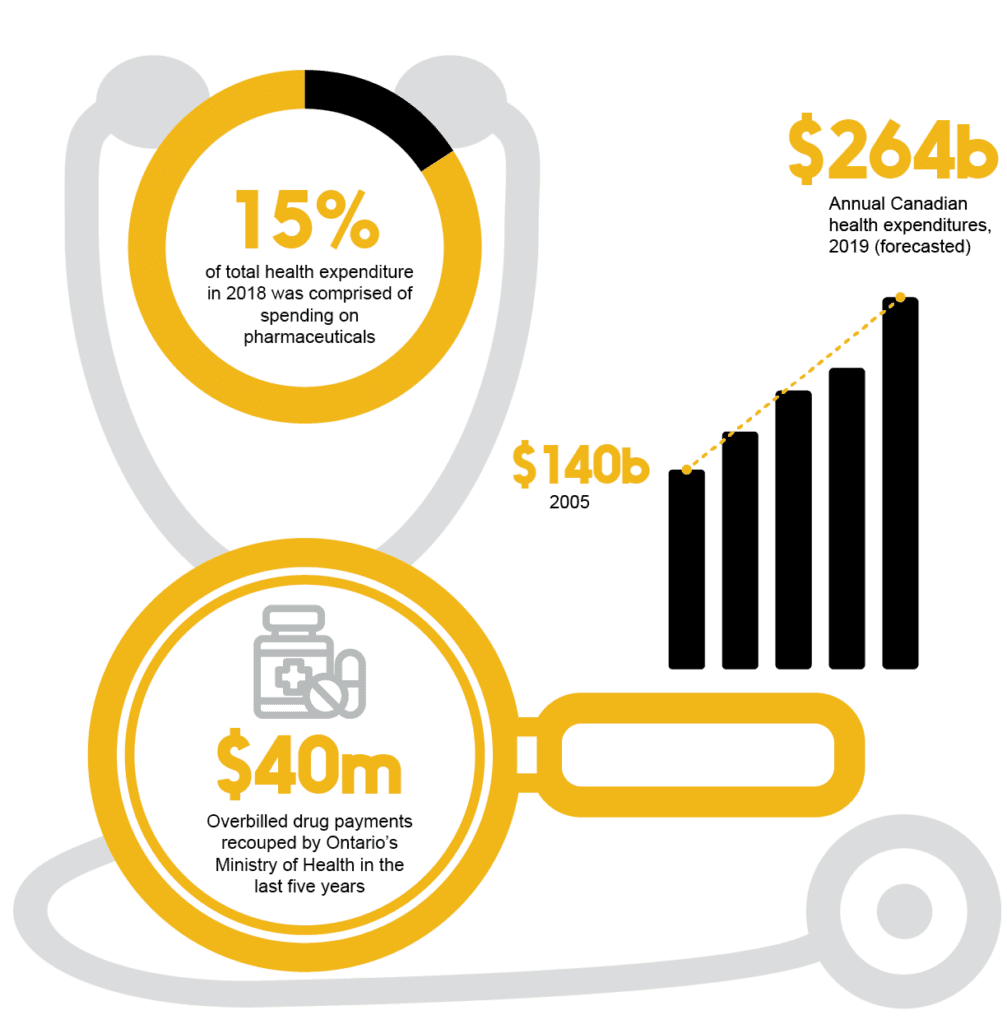
How digital ID helps
Healthcare providers
- Digital ID improves patient satisfaction. Healthcare providers can speed registrations and check-ins, as well as securely provide tele-health and other remotely delivered options for care.
- Digital ID reduces risk by ensuring that only verified patients can order and pick up the drugs that have been prescribed to them.
- Digital ID captures efficiencies by enabling the secure use and sharing of electronic health records in patient care, in government billing and in archival record-keeping.
Patients & families
- Digital ID improves privacy and security, ensuring that a patient can access in-person or online healthcare services without fearing the loss of their personally identifiable information or health data.
- Digital ID offers greater convenience. Through the provision of a digital credential, patients can reduce the paperwork they need to fill out on registration or when moving to a new province.
- Digital ID enhances control of information by allowing patients and their families to better manage which providers have access to their health records.
Using digital ID: a walkthrough
Step 1: Register & schedule
Anna is not feeling well and wants to consult with her family doctor. She downloads the provincial health care mobile application Using her digital ID stored in her mobile wallet, she registers and then selects her doctor. She schedules a virtual consultation.
Step 2: Check-in
On the day of her appointment, Anna logs into the health care application and verifies her identity with the digital ID on her device. She then proceeds with her virtual appointment.
Step 3: Consult
During the appointment, the doctor accesses Anna’s electronic health record (EHR). After the consultation her doctor adds notes and writes a prescription signed with the doctor’s own digital ID. This prescription is automatically synced to the health care application on Anna’s device.
Step 4: Pick up prescription
Anna then sends the prescription to her preferred pharmacy, verifying herself with her digital ID. Once the pharmacy receives and confirms the order, and payment is made, the order is filled and mailed to Anna’s home while her digital prescription is updated with a “filled” status.
Electronic health records (EHRs)
Traditionally, patient health information was kept on paper“charts”, but this made them difficult to store and share. An EHR digitizes this information as a comprehensive, up-to-date report of a patient’s medical history. This can easily be shared with other authorized health service providers, including laboratories, imaging facilities, and more.
Our principles
Digital identity is easy to theorize about, but architecting and implementing a comprehensive, secure, and sustainable system is another matter entirely – and an important part of getting it right is having a clearly articulated set of principles to guide the effort. We believe that there are five:
User control & convenience
No one wants to entrust a system with their personal details if those details are going to be transferred to and stored by numerous parties – especially if this happens without the user’s knowledge and express consent. While ensuring user control, an identity system must also be convenient and easy; if it isn’t, it won’t be adopted by users, many of whom are already used to intuitive apps on mobile devices.
Standards & openness
In any dynamic system, it’s difficult to predict what the future will look like – so it’s important to build today’s solutions on universally-agreed standards. Not only does this reduce costs by eliminating the expense of building and then later having to adapt custom, one-off solutions, but it enables solutions built by others in the future to “plug into” the initial solution. Openness encourages adoption, innovation, and flexibility.
Ubiquity
Security risks abound when people create different identities and passwords for each public and private service they access. They’ll often default to a single, easy-to-remember (and easy to crack) password, for example. At the same time, a digital identity that only applies to a handful of services will probably not be well-adopted. A ubiquitous system is a more convenient and a more secure system.
Trusted brand
No user is likely to adopt an identity solution built or maintained by an organization they don’t trust. The question of identity is simply too important, and the impact of identity theft too great, to leave this to chance. Further, building a large-scale (and ubiquitous) solution will require the cooperation and coordination of many players, and these players need to trust each other and the organization leading the effort.
Security via abstraction
Even with the best user controls, a certain amount of identity data must be part of transactions in any given ecosystem. A highly effective way of securing that data is to “abstract” it, by replacing a private identifier with a publicly available one (like a person’s email address) or by replacing it with a randomized number that serves as an authorized “token” for the purposes of the transaction – and is not useful for any other purpose.
Conclusion
Driven partly by new technology and partly by the impact of the pandemic, health care in Canada is undergoing an evolution in delivery methods. Digital ID has a central role to play in this evolution, helping to secure patient information, make registration and billing more efficient, and prevent identity theft and pharmaceutical fraud – among many other benefits. This is part and parcel of digital ID’s positive impact on an even wider range of industries (for more information, see our recent white papers on digital ID in alcohol and cannabis, and in lotteries and gaming), an impact we’re excited to be helping to make real.
If you’re interested in collaborating with Interac on the future of Digital ID, drop us a line at digitalid@interac.ca
The march for Digital Health Care and ID is real, active and underway. Apparently they want your input.
The white paper can be found here and in the within the web page:
https://www.interac.ca/wp-content/uploads/2021/06/Digital_ID_Healthcare_White_Paper_Eng.pdf
So dear readers, do we have tin-foil hats when we believe in Canada, they are marching us towards a digital ID, Health records and financial, social credit and control system? Some might say its a theory, but when we see the ongoing work, to develop and justify it: it is hardly theory, it is a fact. It is not even a conspiracy, once it is out in the open. It’s a fact-fact.
Fact check that. And for symmetry, I’d like to Tony Blair Book end this.




Sources: lawyerlisa.substack HNewsWire HNewsWire