


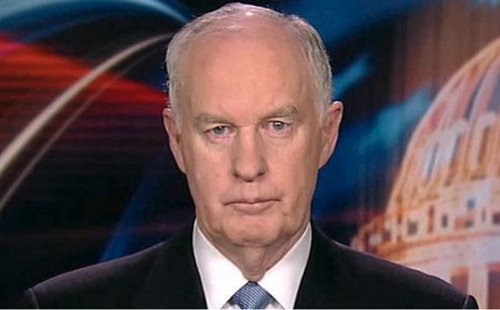
Calls for President Trump to Invoke Insurrection Act ,Suspend Habeas Corpus, Declare Martial Law and Initiate Mass Arrests Under Military Authority…
What took place in America was not merely “vote fraud” but rather “cyber warfare.” These were acts of war against America, using cyber warfare weapons and techniques to overthrow the government via a rigged elections process. SRH.
In My Opinion, We Are Already Under a Form of Martial Law, SRH.

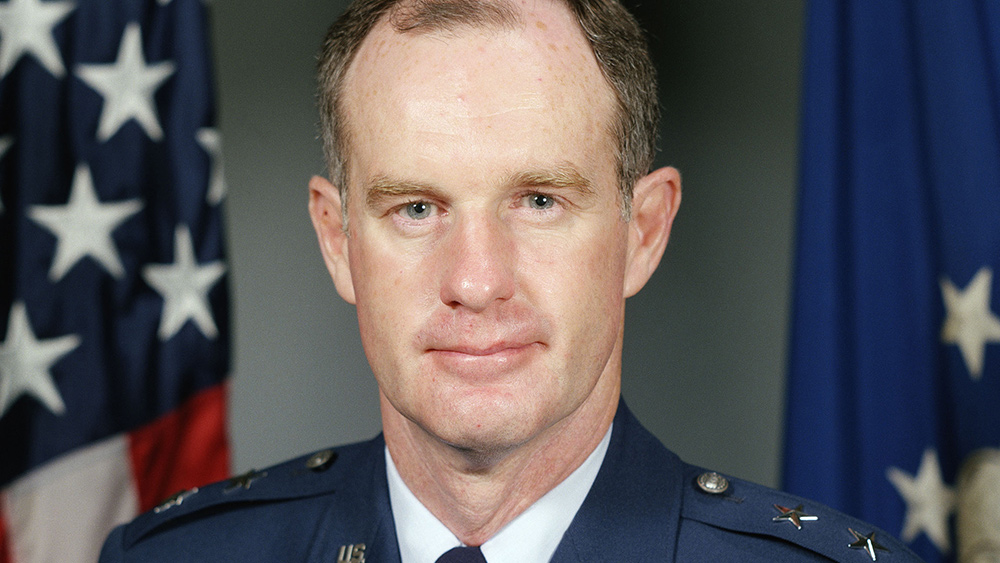
Brannon House of WVWtv.com has published another bombshell interview with retired 3-star General Thomas McInerney, who is openly calling on President Trump to recognize severity of the cyber war assault on America by invoking the Insurrection Act, suspending Habeas Corpus (as Lincoln did) and initiate mass arrests under military authority. The original, full interview is found at this link from WVWtv.com. We have posted a six-minute summary of the video highlights below, via Brighteon.com. This call by Gen. McInerney, a highly-accomplished military veteran and loyal patriot, appears to be stemming from a realization that much of the existing government has gone rogue and is now colluding with enemies of the nation. State governors have gone rogue, court judges have gone rogue and state election officials have willfully engaged in coordinated, treasonous election rigging in order to achieve the overthrow of the executive leader, President Trump. When government officials go rogue, and courts cannot be trusted, military authority can be invoked by the President, complete with mass arrests of treasonous actors, military tribunals that bypass the civilian court system, and the military seizure of all corporations that are actively working to undermine the United States of America. This would obviously include Big Tech and most of the left-wing media that has been complicit in election rigging and acts of journo-terrorism designed to plunge this nation into despair.
Highlights from this Howse / McInerney video
Here are my own highlights from this critical interview, and you can watch the six-minute highlight video below, or view the full interview at WVWtv.com. All items in quotation marks are direct quotes from McInerney, during the interview.
- What took place in America was not merely “vote fraud” but rather “cyber warfare.” These were acts of war against America, using cyber warfare weapons and techniques to overthrow the government via a rigged elections process.
- McAnarney calls for President Trump to invoke the Insurrection Act, suspend Habeas Corpus, declare martial law and deploy the military to seize and secure all the voting machines.
- Six to ten states were coordinated via cyber warfare to change the outcome of the election. “These are treasonous acts.” Russia, China and Iran were also involved, adding to the treason.
- FBI and DOJ are completely AWOL on all this, not lifting a finger.
- Chris Krebs from CISA was lying when he claimed the election was “perfect.” This is “complicity to treason” and Krebs is part of the deep state.
- President Trump must declare a national emergency based on the EO from Sep 12, 2018, which names “foreign interference” in US elections.
- Trump should also invoke the Insurrection Act. He must suspend Habeas Corpus as Lincoln and FDR have both done in times of war.
- The Democrats, Russians, Chinese and Iran, have committed blatant cyber warfare against America.
- The President must “start arresting these people right away, [under] this national emergency. I would declare martial law.”
- Officials from five swing states were engaged in “pre-planning” of “treasonous acts.” Not just fraudulent voting, but treason. “They have tried to overturn this government.”
- Chris Miller is in place at the DoD because “the military active duty is going to have to suppress [Antifa and BLM].”
- The President should suspend the Dec. 14th Electoral College meeting, and the inauguration of the new Congress on Jan. 6th.
- Estimates that 85 million people voted for Trump.
- Military tribunals are necessary because the regular courts are not capable of sorting this out.
- The treasonous actors should be arrested and charged, subjected to military tribunals. This is the only system of justice that is capable of functioning without the current level of corruption.
- Suspend the inauguration until this election is fully investigated.
- We the People demand this action from the President.
- “This is the last free election we will have” if we don’t expose this election fraud. And Georgia’s runoff election will be stolen using HAMMER, Scorecard and Dominion voting machines.
- The Georgia runoff election needs to be suspended until the election fraud is fully investigated.
- “This corruption cannot be accepted. It is treasonous, and we must have a thorough investigation of it.”
- The President must support and defend the Constitution of the United States against all enemies, foreign and domestic. These are domestic enemies. “Like Stalin says, it doesn’t matter who votes, it matters who counts the votes.”
- America’s judicial system people don’t understand how cyber warfare works. So they are missing a real grasp of the crimes and acts of war being committed against the United States.
- “The ownership and leadership of Fox News is complicit in a treasonous act.”
- U.S. Marshals should have seized all the Dominion servers the day after the election and secured them as forensic evidence.
- People who changed votes in the machines should know that they will be prosecuted for treason and may face the death sentence.
- The government is tracking the conversions of ballots to votes. “That’s where the manipulation is coming in. We’re tracking that. We have that information.”
Here’s the six-minute overview video. Feel free to post this elsewhere: Brighteon.com/7497ff5e-44b3-44d4-9363-c9fcbea100bahttps://www.brighteon.com/embed/7497ff5e-44b3-44d4-9363-c9fcbea100baHere’s my latest Situation Update podcast that analyzes many of these same issues. I’m currently producing one of these podcasts each day, and they come out around 1pm central time, at Brighteon.com. I am committed to producing these until the current election situation is resolved. Brighteon.com/df4e479e-ae5e-4995-90e7-74848980a616https://www.brighteon.com/embed/df4e479e-ae5e-4995-90e7-74848980a616Hear all the Situation Updates from previous days at the Health Ranger Report channel on Brighteon.com: https://www.brighteon.com/channels/hrreport God bless America.


When government officials go rogue, and courts cannot be trusted, military authority can be invoked by the President, complete with mass arrests of treasonous actors, military tribunals that bypass the civilian court system, and the military seizure of all corporations that are actively working to undermine the United States of America. This would obviously include Big Tech and most of the left-wing media that has been complicit in election rigging and acts of journo-terrorism designed to plunge this nation into despair.
“These are treasonous acts. Not just fraudulent acts. They’re treasonous acts. Because it means changing the government. Then when you add Russia, China, and Iran, foreigners into it, you complicate it and make it even more treasonous.”
~ Gen. McInerney
McInerney also said the fraud seen on Election Day could easily be repeated in Georgia to steal the two U.S. Senate seats up for election there on Jan. 5, giving Democrats full control of the government.
McInerney said President Trump must be compelled by his supporters to “honor his oath of office” and employ the tools available to him to quash the insurrection that he believes is in progress.
According to attorney Sidney Powell, speaking in an interview with Lou Dobbs, the Dominion Systems machines were set to give Biden a weighted count of 1.25 votes for every one vote he received, while Trump’s votes were set at 0.75 percent of each vote he received. This means that 2.7 percent of the votes were switched from Trump to Biden in multiple battleground states.
Massive fraud was also reported with the mail-in ballots in Michigan, Pennsylvania, Georgia, Wisconsin, Nevada and now Arizona.
At a public hearing Monday held by state legislators in Arizona, witnesses reported their state had 1.9 million mail-in ballots that were separated from envelopes without any signatures that could be verified. Similar reports dripped out of Georgia, Michigan and Pennsylvania.
The retired three-star general was very specific in what he said Trump must do to put down the coup. He must invoke the executive order that Trump signed on Sept. 12, 2018, allowing the president to declare a state of emergency related to foreign intervention in U.S. elections.

/cloudfront-us-east-1.images.arcpublishing.com/mco/MDSJE3DMGFHHHLFQ34FH5ZLGUA.jpg)
In short, martial law can be imposed when civil rule fails, temporarily being replaced with military authority in a time of crisis. Though rare, there have been a number of notable U.S. cases where martial law came into play, including in times of war, natural disaster and civic dispute — of which there has been no shortage in 2020.
While no precise definition of martial law exists, a precedent for it exists wherein, “certain civil liberties may be suspended, such as the right to be free from unreasonable searches and seizures, freedom of association, and freedom of movement. And the writ of habeas corpus [the right to a trial before imprisonment] may be suspended,” according to documents from JRANK, an online legal encyclopedia.
Martial law may be declared by both the president and by Congress. State officials may also declare martial law, according to the Brennan Center for Justice, however, “their actions under the declaration must abide by the U.S. Constitution and are subject to review in federal court.”
“Notorious examples include Franklin D. Roosevelt’s internment of U.S. citizens and residents of Japanese descent during World War II and George W. Bush’s programs of warrantless wiretapping and torture after the 9/11 terrorist attacks,” the Atlantic reported. “Abraham Lincoln conceded that his unilateral suspension of habeas corpus during the Civil War was constitutionally questionable, but defended it as necessary to preserve the Union.”
Throughout the course of U.S. history, federal and state officials have declared martial law at least 68 times, according to Joseph Nunn, an expert with the Brennan Center for Justice.
How does it work?
Martial law does have limits. The Posse Comitatus Act, passed on June 18, 1878, prevented federal troops from supervising Confederate state elections during Reconstruction. Though initially it only applied to the Army, it has been amended to include the Defense Department and, of course, the other service branches. That act prevents troops from enforcing domestic law, preventing such actions as searching and seizing property or dispersing crowds. However, National Guard units, which take their direction from state governors, are exempt from the Posse Comitatus Act.
One exception to Posse Comitatus, however, is the Insurrection Act, which allows the use of active-duty or National Guard troops for federal law enforcement in cases when “rebellion against the authority of the U.S. makes it impracticable to enforce the laws of the U.S. by the ordinary course of judicial proceedings,” according to U.S. Northern Command.
The text of the Act reads:
“Be it enacted by the Senate and House of Representatives of the United States of America in Congress assembled, That in all cases of insurrection, or obstruction to the laws, either of the United States, or of any individual state or territory, where it is lawful for the President of the United States to call forth the militia for the purpose of suppressing such insurrection, or of causing the laws to be duly executed, it shall be lawful for him to employ, for the same purposes, such part of the land or naval force of the United States, as shall be judged necessary, having first observed all the pre-requisites of the law in that respect.”
But activating the National Guard even under federal Title 32 status, in which the federal government helps pay for Guard troops under state control, does not fall under the Insurrection Act, nor does it equate to martial law in ordinary circumstances.
“Governors call the National Guard all the time to respond to a storms or power outages, delivering medical supplies, stuff going on even during COVID,” Banks said. “That’s not extraordinary, nor would it be if the President federalized the National Guard for similar reasons, responding to a need to disseminate vaccines next winter, for example, would be perfectly appropriate, lawful, not martial law.”
Should we be worried?
“The sort of hellish scenarios that some people talk about is one where the president orders or regular military armed forces the United States to take over cities that he believes are engaged in an unlawful election, disruption or protests in the wake of an unresolved presidential election in the days after November 3,” Banks noted.
Though purely a hypothetical, Banks notes that the way it would happen would be through the Insurrection Act. In order to invoke the Insurrection Act, the president “must first issue a proclamation ordering the insurgents to disperse within a limited time, 10 U.S.C. § 334.4. If the situation does not resolve itself, the President may issue an executive order to send in troops,” according to a 2006 Congressional Research Service report.
“One of the important things to remember about the Insurrection Act is that it’s not martial law,” Banks said. “The purpose of utilizing the mechanisms of insurrection act is to enforce the law, not replace it.”
In June, at the height of the protests surrounding the death of a Black man named George Floyd at the hands of a white Minnesota police officer, President Donald Trump alluded to the Insurrection Act as a means of calling up active duty troops to quell civil unrest as protest erupted across the country.
“If a city or state refuses to take the actions that are necessary to defend the life and property of their residents, then I will deploy the United States military and quickly solve the problem for them,” Trump said in a White House statement on June 1 — just before he posed for a photo opportunity outside Washington, D.C.’s St. John’s Church with a bible amid an entourage, which included Joint Chiefs of Staff Chairman Gen. Mark Milley.
Milley publicly apologized for his appearance in Trump’s walk across Lafayette Square to pose for photos in front of a church partially burned during protests.
“My presence in that moment and in that environment created a perception of the military involved in domestic politics,” Milley said. “As a commissioned uniformed officer, it was a mistake that I have learned from, and I sincerely hope we all can learn from it.”
But while the Insurrection Act is law, the fact that martial law is not codified lands its use in a distinctly grey legal area.
“One of the problems, of course, is that there’s nothing to prevent the president or a military commander from declaring martial law,” Banks noted. “They can just do it. It’s not sanctioned by law.”
Banks noted that the civilian in charge of the military — in this case, Defense Secretary Mark Esper — is the key to ensuring the military is kept out of the 2020 elections.
“Secretary Esper is in a in a really critical role here,” Banks noted.
Esper addressed this in a memo to the force.
“As citizens, we exercise our right to vote and participate in government,” he wrote. “However, as public servants who have taken an oath to defend these principles, we uphold DoD’s longstanding tradition of remaining apolitical as we carry out our official responsibilities.”
Milley too feels strongly about the necessity of keeping the U.S. military out of politics and the election.
“We don’t swear an oath of allegiance to an individual, a king, a queen, a president or anything else,” he said in an interview with NPR. “We don’t swear an oath of allegiance to a country, for that matter. We don’t swear an oath of allegiance to a flag, a tribe, a religion or any of that. We swear an oath to an idea, or a set of ideas and values, that are embedded in our Constitution.”
As a result of these comments, Banks is optimistic that the worst case election scenario in the event of disputed election results might just be lawsuits in certain states where the outcomes are murky.
“A really important limitation in the event that there is martial law is that it’s highly unlikely to be tolerated in a situation where our civilian institutions are working,” Banks noted. “Martial law requires a complete meltdown. It requires the inability of our civilian institutions to manage government. It’s hard to imagine that.”

Source: HNewsWire militarytimes.com distributednews HNewsWire HNewsWire HNewsWire
StevieRay Hansen
Editor, HNewsWire.com
Watchmen does not confuse truth with consensus The Watchmen does not confuse God’s word with the word of those in power…

