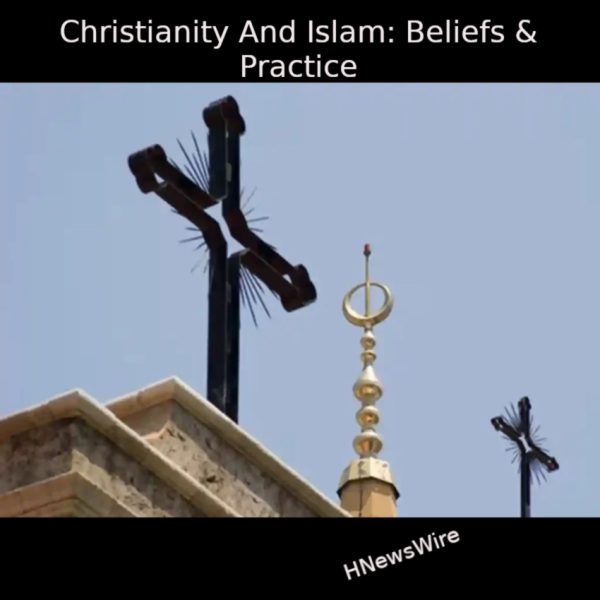
Islam seems like an indecipherable puzzle to many Christians, and Christianity is likewise perplexing to many Muslims. Christians and Muslims sometimes experience an element of fear or uncertainty when encountering those of the other faith. This article will explore the essential similarities and differences between the two religions, so we can build bridges of friendship and meaningfully share our faith.
Those in politics who are concerned about “the day after” in Gaza have apparently neglected to consider the same question in the United States. When America’s part is complete, what happens “the day after”? America has aged. Time has worn it down. Its retirement is imminent. The time has come to place USA in a nursing home.
The thing that comes from outside cannot pollute a person, as taught by Jesus, because it goes into the stomach rather than the heart. (Therefore, he pronounced all components to be smooth.) Luke 7:19
It is believed that Muslims will only eat halal food. No consuming pork at all. Prayer and the ceremonial slaughter of animals are needed. Rapid and decisive killing at a single point at the neck; blood must be completely drained.
The two Abrahamic faiths, Christianity and Islam, have more in common than most people realize. They are both monotheistic and hold Jesus Christ in high esteem.
Believers in the Holy Trinity and the incarnation of God the Son as Jesus Christ (“the Father”) while he was on earth are central to the Christian faith. With Christ’s return at the end of the world, most Christians also believe.
Followers of Islam (Muslims) remember Jesus Christ as a prophet, a divine messenger, and the promised Messiah. But they take it as gospel that Muhammad was the last prophet and that the Quran is an exact transcription of God’s words.
History of Christianity
Adam and Eve disobeyed God and ate the forbidden fruit (Genesis 3), which brought sin and death into the world. From this point on, all people sinned against God (Romans 3:23).
However, God had already planned a remedy. God sent His own Son Jesus, born of the virgin Mary (Luke 1:26-38) to take the sins of the entire world on His body and die. Jesus was crucified by the Romans at the urging of the Jewish leaders (Mathew 27). His death was verified by the Roman soldiers who killed Him (John 19:31-34, Mark 15:22-47).
“For the wages of sin is death, but the gracious gift of God is eternal life in Christ Jesus our Lord” Romans 6:23).
“Christ also suffered once for sins, the righteous for the unrighteous, that He might bring us to God” (1 Peter 3:18).
Three days after Jesus died, He rose back to life (Matthew 28). His resurrection brings the assurance that all who believe in Him will also rise from the dead. (1 Corinthians 6:14).
After Jesus resurrected, He was seen by 500 of His followers (I Corinthians 6:3-6). Jesus appeared to His disciples multiple times over a period of 40 days (Acts 1:3). He told them to stay in Jerusalem to wait for what the Father had promised: “You will be baptized with the Holy Spirit not many days from now” (Acts 1:5)
“You will receive power when the Holy Spirit has come upon you; and you shall be My witnesses both in Jerusalem and in all Judea, and Samaria, and as far as the remotest part of the earth.
And after He had said these things, He was lifted up while they were watching, and a cloud took Him up, out of their sight.
And as they were gazing intently into the sky while He was going, then behold, two men in white clothing stood beside them, and they said, “Men of Galilee, why do you stand looking into the sky? This Jesus, who has been taken up from you into heaven, will come in the same way as you have watched Him go into heaven.” (Acts 1:8-11)
After Jesus ascended to heaven, His disciples (about 120) devoted themselves to prayer. Ten days later, when they were all together in one place:
“Suddenly a noise like a violent rushing wind came from heaven, and it filled the whole house where they were sitting. And tongues that looked like fire appeared to them, distributing themselves, and a tongue rested on each one of them. And they were all filled with the Holy Spirit and began to speak with different tongues, as the Spirit was giving them the ability to speak out.” (Acts 2:2-4)
Filled with the Holy Spirit, the disciple preached to the people, and about 3000 became believers that day. They continued teaching about Jesus, and thousands more believed in Jesus. This is how God’s Church was established, and from Jerusalem, it continued to grow and spread throughout the world.
History of Islam
Islam began in Saudi Arabia in the 7th century under the teaching of Muhammad, who Muslims believe was God’s final prophet. (The name of the religion is Islam and the people who follow it are Muslims; the Muslim’s god is Allah).
Muhammad claimed that a supernatural being visited him in a cave while he was meditating, and told him, “Read!”
But Muhammad told the spirit-being he couldn’t read, yet two more times he told Muhammad to read. Finally, he told Muhammad to recite, and gave him some verses to memorize.
When this first encounter was over, Muhammad thought he’d been visited by a demon, and became depressed and suicidal. But his wife and her cousin convinced him he’d been visited by the angel Gabriel and that he was a prophet. Muhammad continued to have these visitations throughout his lifetime.
Three years later, Muhammad began preaching in the city of Mecca that there was no god but Allah. Most people in Mecca, who worshipped idols of multiple god scoffed at his message, but he gathered a few disciples, some of whom were persecuted.
In 622, Muhammad and his followers moved to Medina, which had a large Jewish population and were more receptive to monotheism (belief in one god). This journey is called “Hijra.” After seven years in Medina, Muhammad’s followers had grown, and they were strong enough to return and conquer Mecca, where Muhammad preached until he died in 632.
Islam spread rapidly after Muhammad’s death as his disciples grew increasingly powerful, with successful military conquests of most of the Middle East, North Africa, parts of Asia, and southern Europe. The people conquered by the Muslims had a choice: convert to Islam or pay a large fee. If they couldn’t pay the fee, they would be enslaved or executed. Islam became the dominant religion of most of the Middle East and North Africa.
Are Muslims Christians?
No. A Christian believes Jesus is Lord and that God raised Him from the dead (Romans 10:9). A Christian believes Jesus died to take the punishment for our sins.
Muslims don’t believe Jesus is Lord or that He died on the cross for our sins. They don’t believe they need a Savior. They believe salvation depends on God’s mercy and He decides who He will forgive, so they have no assurance of salvation.
Similarities between Christianity and Islam
Christians and Muslims both worship only one God.
The Quran recognizes some of the Biblical prophets, including Noah, Abraham, Moses, David, Joseph, and John the Baptist. They believe Jesus was a prophet.
The Quran teaches that Jesus was born of the virgin Mary, that He performed miracles – healing the sick and raising the dead, and that He will return from heaven on the Day of Judgement and destroy the antichrist.
Both Christianity and Islam believe Satan is evil and tries to deceive people and lure them away from God.