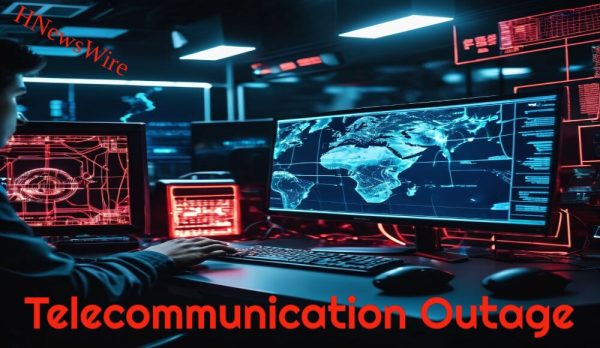
Global internet monitor NetBlocks has reported in a post on social media X platform that millions of Optus customers cannot make calls or use the internet due to a major nationwide outage.
“Metrics show Optus mobile services are down across much of Australia, leaving millions of customers unable to make calls or access internet since early morning; authorities said to be investigating possible cyberattack as trains and infrastructure disrupted,” NetBlocks said.

Optus is aware of an issue that may be impacting some of our mobile and internet customers,” the telecommunications company wrote in a statement.
Australian Broadcasting Corporation said, “Federal authorities are checking whether the outage is the result of a cyber attack, although, at this stage, they do not believe it is a hack.”
*Developing…

HNewsWire: It’s impossible to overstate the value of a reliable electrical grid. When a grid fails, it can have devastating consequences. The United States’ electrical grid is among the most susceptible to disruption from outside forces.
The electrical transmission lines in the United States are in danger from state-sponsored hackers from countries like Iran, Russia, and, unexpectedly, China. However, electric vehicles pose a separate, less evident threat to the grid (EVs).
It is a top priority for the Biden administration to finally put the internal combustion engine in the junkyard of history. Americans are being urged to adopt EVs as part of a drastic move toward a new, zero-emission future. However, such an embrace demands an exceptionally reliable electrical system, which is precisely what the United States lacks.
The U.S. power grid (or electric grid) consists of a massive interconnected system of transmission lines, power plants, and distribution hubs. The Eastern Grid, the Western Grid, and the ERCOT Grid (sometimes known as the Texas Grid) are the three largest grids in the United States. The Eastern Grid is by far the biggest of the three.
The three grids have the ability to function separately, but they are also interconnected. If the grid goes down, millions of people will be left in the dark for hours on end. Think about what would happen if the electricity suddenly went out in a major city like Los Angeles or New York. The two cities have a high crime rate to begin with, and if the power grid were to go down, the situation would quickly become catastrophic.
Conflicts Since 2016In 2018, DHS reported that Russian hackers had gained access to the control centers of several different power companies. Because of this, the hackers were able to cause power outages by disrupting electricity flows.
Disconcertingly, the DHS admitted that the attacks have been going on since 2016-the same year that Russia began assaulting Ukraine’s power grid. Even while Russia has denied any involvement in the attack, this denial seems to run counter to the facts.
An increase in grid disruptions is to be expected as relations between Russia and the United States rise, as do tensions between the United States and China, another hacker-friendly country.
Americans, however, have more “benign” threats to worry about. The danger that electric cars pose to the electrical grid was the subject of a recent research in Applied Energy. There are currently 2.5 million EVs on U.S. roads, with 80% of their owners preferring to charge their vehicles while they sleep. The researchers claim that this choice places a heavy burden on existing electrical infrastructure.
More than 20 million electric vehicles (EVs) will be driven in the United States by 2025. More than half of all vehicle sales will be electric vehicles by 2030, according to Bloomberg. Power grids are struggling to keep up with the rising demand.
Bloomberg’s prediction, if realized, would necessitate 5.4 gigawatts of energy storage to power EVs, as pointed out by the study’s authors. To give you an idea of how much electricity 5.4 gigawatts represents, consider that a single nuclear power plant generates 1 gigawatt. As of right now, there are 55 power plants in operation across the United States.
The United States needs more of these vehicles in order to support the emerging EV revolution. The largest state in the country has already taken steps to outlaw the sale of gas-powered cars, and other states are considering proposing similar regulations, so the rest of the United States needs to get moving. Our time is of the utmost importance.
In EV-crazy California, what would happen if the power system suddenly went down, for example? We need just go back a few months to find the answer to that question. Due to extreme heat this past summer, the power grid in California came dangerously near to failing.
It held on for dear life and barely made it. There will be further testing of the grid. Given California’s plans to increase demand for electric vehicles, the upcoming trial could be a total failure. So many proponents of electric vehicles appear oblivious to the notion that energy is a limited resource.
In this image from the Canadian International AutoShow in Toronto on February 13, 2019, we see the charging port on a Mercedes Benz EQC 400 4Matic electric vehicle.
In reality, the United States’ electricity grid is failing. For a long time now, indeed. Dr. Massoud Amin, a professor of Electrical and Computer Engineering (ECE) at the University of Minnesota, recently wrote a frightening article for Smithsonian Magazine detailing the several ways in which the United States’ electrical grid, “the most complicated” one ever created, could fail. According to his article, “the grid underlies our economy, our quality of life, and our civilization,” and its loss would cause a complete collapse of these aspects of society. There will be a surge in criminal activity. Human lives will be lost. There will be complete anarchy.
The American Society of Civil Engineers estimates that the failure to invest in the upkeep of the country’s extensive electrical grid will cost the United States $130 billion by 2025. Despite being heralded as “the greatest thing since sliced bread,” EVs have a number of significant drawbacks.
Author Ben Guess recently pointed out that there are already 21 EVs for every public charging connection in the United States. In order for the United States to keep up with the rising demand for electric vehicles, over 500 new charging outlets will need to be installed every day until 2030.
Do you think this is a reasonable assumption?
There just aren’t enough outlets for battery-related usage on the grid, even if the United States manages to add enough ports. This needs to be said over and over without ever apologizing for its importance. Indeed, state-sponsored hacking poses a hazard, but neither are state-sponsored electric vehicle (EV) projects without their own risks. We must not lose sight of the forest for the trees in our enthusiastic embrace of everything environmentally friendly.
An Outage In The United States’ Power Grid Could Leave The Country In The Dark; Prepare For Insanity
Authored by John Haughey via The Epoch Times (emphasis ours),
There were approximately 10,000 energy projects in April designed to produce more than 2,000 gigawatts (GW) of collective power waiting for permits from federal and state agencies to connect to electric grids across the United States.

The problem is, that is nearly twice the collective electricity output of the 1,250 GW now being produced by all the nation’s power plants, most of which were built to generate power using fossil fuels.
Therefore, two bottlenecks are looming-more power is trying to squeeze into an inadequate grid and coal-fired plants are being retired faster than new plants using renewable energy sources such as wind and solar are being built to replace them.
“The United States is heading for a reliability crisis,” Federal Energy Regulatory Commission (FERC) Commissioner Mark Christie warned on May 4 in a hearing before the Senate Energy & Natural Resources Committee.
“I do not use the term ‘crisis’ for melodrama, but because it is an accurate description of what we are facing,” Christie said. “I think anyone would regard an increasing threat of system-wide, extensive power outages as a crisis.”
Committee chair Sen. Joe Manchin (D-W.V.) and ranking Republican Sen. John Barrasso (R-Wyo.) agreed, with both identifying the same culprit in an “impending, but avoidable, reliability crisis” that confronts the nation’s electricity grid.
The “premature fossil retirements” amid increasing demand for power are a result of President Joe Biden’s green energy initiatives in 2021’s Bipartisan Infrastructure Law (BIL) and 2022’s Inflation Reduction Act (IRA) that incentivize investments in renewable energy.
The incentives have proven effective in inducing investor interest-maybe too successful with projects being proposed and approved sooner than expected and faster than the grid’s transmission capacity is expanding.
The Biden administration is “trying to force a dramatic increase in electrical demand” through the BIL and IRA, Manchin said, which will foster disruptions in transmission as old plants are retired and new ones come online.
“We do have to address climate change but this transition is happening too fast,” he said, noting he and House Republicans have filed bills that address transmission. “I hope we can sit down and negotiate in good faith and put politics aside.”

Natural Gas Shunted Aside
Barrasso blasted the Biden administration for contributing to the pending energy transmission bottleneck by discouraging natural gas pipeline development, citing an April U.S. Energy Information Agency (EIA) report that documented the least amount of pipeline was built in 2022 than any time since such record-keeping began in 1995.
Without restoring “balance” in the nation’s energy equation that includes coal, natural gas, and oil, “energy prices will skyrocket, grid reliability will degrade, and families all across the country will suffer,” Barrasso said.
Christie was one of the four FERC commissioners to address the Senate committee during a hearing on the agency’s $520 million fiscal year 2024 budget request, but few questions posed by senators during the session directly addressed the proposed spending plan.
Under the Federal Power Act, Natural Gas Act, and Interstate Commerce Act, among other legislative and administrative actions, FERC is responsible for managing the nation’s electrical grid.
More than 5,200 megawatts (MW) of oil, coal, and nuclear power plant energy generation were “retired” between 2013 and 2022, and another 5,000 MW of coal- and oil-fired generation could be retiring in coming years, according to the U.S. Energy Information Agency (EIA).
Coal-fired plants that generate more than 200,568 MW of energy plan to shut down by 2029 because of “continued competition from natural gas and renewable resources” and higher operating costs associated with older, less efficient coal-fired generators, the EIA reported in November 2022.
It said an average of 9,450 MW of coal-fired electricity was retired annually between 2012 and 2021. U.S. coal-fired plant retirements totaled 11,778 MW of capacity in 2022. That trend is expected to continue at least through 2029 when, the EIA projects, 23 percent of the remaining 200,568 GW of coal-fired energy will go offline.
Michigan, Texas, Indiana, and Tennessee will see the most “coal-fired capacity retirements” through 2029, accounting for a combined 42 percent of energy generation in those four states that will need to be replaced.
Natural gas is also leaving the grid faster than it is being replaced. In November, FERC anticipated 107 units of “high-probability” natural gas units totaling 17,062 MW capacity would go online by September 2025. Over that same time span, however, 130 units totaling 17,489 MW of natural gas power will go offline.
By September 2025, FERC anticipates that the amount of electricity produced by renewable energies will grow from about a quarter of the nation’s power generation to one-third of “available, installed generating capacity.”
Utility-scale solar and wind generating capacity would expand from 17.37 percent of domestic capacity to 23.24 percent by September 2025, with solar and wind accounting for 11.23 percent and 12.01 percent, respectively, according to FERC.
While the sharp increase in FERC’s three-year forecast for wind and solar, coupled with coal-fired plant retirements and the “apparent peaking of natural gas” as a source of electrical generation applauded by renewable energy proponents, even those who support the shift to renewables are raising alarm about the timing of a transition that is happening faster than government capacity to plan and regulate.

FERC $520 Million Budget Not On Agenda
Much of the hearing focused on interim FERC Chair Willie Phillips, named by Biden in January to succeed Richard Glick, a Democrat criticized by Senate Republicans and Manchin for imposing new guidelines on natural gas projects and incorporating pipeline emissions in permitting reviews.
Machin addressed the pile-on of new greenhouse gas regulations imposed by the Biden administration as “simply staggering” during the May 4 hearing.
Biden originally nominated Glick for another term but in November Manchin said he was “uncomfortable” with the renomination and would not hold a required confirmation hearing before his committee.
Machin endorsed Phillips as chair in a Jan. 3 statement that called him “a supremely qualified and reasonable person” who “understands the need to balance affordability and reliability.”
Barrasso said he also backs Phillips’s confirmation as FERC chair, praising him for “resetting the agenda to bring forward discussions for action” with an “emphasis on energy availability and affordability.”
While he doesn’t always agree with him, Barrasso told Phillips, “Under your leadership, the commission has made great progress since you took over just a couple of months ago.“
Phillips, who was District of Columbia Public Service Commission Chair from 2018 to 2021, has served as a FERC commissioner since December 2021.
A regulatory attorney, he has been criticized by Public Citizen and other consumer groups as too accommodating to utilities, primarily from his stint as counsel for the North American Electric Reliability Corp, a public-private entity that assists FERC in grid development.
With Phillips serving as chair, the five-seat FERC commission is down one member and evenly split between Democrats and Republicans. A fifth commission nominee has not been put forward by the administration.
Phillips and Allison Clements are the commission’s two Democrats with Christie and James Danly as its two Republicans. All addressed the Senate panel on May 4.
The Electric Power Supply Association and Interstate Natural Gas Association of America are among industry groups raising fears that the 2-2 deadlock can delay projects, including the transmission of zero-emissions electricity into the utility grid, efforts to bolster climate-weather resiliency, and the warding off of cyber-attacks.

New Chair, New FERC Priorities
Phillips said one of the first things he did as FERC chair was clearly reiterate the agency’s reason for existing.
“It is our responsibility to ensure that rates for the wholesale sale and transmission of electricity, as well as the transportation of oil and natural gas by pipeline, in interstate commerce are just and reasonable,” he said in his testimony.
FERC is also responsible for permitting and regulating energy infrastructure-plants and transmission lines-and that includes “interstate natural gas pipelines” and “facilities for exporting or importing Liquified Natural Gas.”
Phillips said that after clarifying FERC’s mission, he sent forth three priorities: reliability, electric transmission, and environmental justice.
“I am happy to report that, in a few short months, we have made substantial progress on all three fronts,” he told the panel.
Reliability “is-and always must be-job number one” for the commission when the nation faces “unprecedented challenges to the grid’s reliability,” Phillips said.
“Foreign and domestic actors are testing our cyber defenses every day. Physical threats to the grid are on the rise. And extreme weather of all kinds is threatening power to customers across the country,” he said.
Among the steps in addressing cyber security is the January finalization of a rule that requires the North American Electric Reliability Corporation (NERC) to develop “enhanced cybersecurity standards,” Phillips said.
NERC, a not-for-profit public-private regulatory entity provides FERC with reliability and security assessments of grid integration from Canada to northern Mexico.
In February, Phillips said, the FERC Commission updated and enhanced winter preparedness measures recommended by NERC “designed to help prevent a repeat of the grid impacts we saw” in 2021 winter storms, especially in Texas.
The commission in March approved new reliability standards to “further protect our electric system supply chain from hostile actors,” he said, adding in April it “issued yet another final rule,” this time implementing the requirement in [BIL] to establish incentives to induce cybersecurity investments.
“These actions represent the ‘blocking and tackling’ that is absolutely necessary to ensure that our electric grid remains secure, reliable, and resilient,” Phillips said.
FERC’s second priority under his leadership is transmission, he said.
Transmission “is, in itself, a reliability imperative,” Phillips said, calling transmission “the key that can unlock the potential of so many of the energy security measures” in the BIL and IRA.
Phillips said FERC has several “rule-making” priorities it wants to implement in the coming year to enhance transmission.
“First, my highest priority in the near term is to finalize a proposed rule that will greatly improve our processes for interconnecting new electric generating resources, reducing the time it takes to bring those resources online,” he said.
“In addition,” Phillips added, “we are working to finalize a second proposed rule on how to plan and pay for badly needed regional electric transmission facilities.”
A third proposed transmission-related rule would provide the FERC commission with the “backstop siting authority” accorded it under the BIL.
Philips said his third priority as FERC chair is environmental justice.
“For me, this is personal,” he told the Senate panel, recalling growing up in “an environmental justice community in Alabama” where he experienced “firsthand what it means for a community to bear more than its fair share of pollution and the other costs of industrial development.”
He balanced that experience with recognizing “the benefits that investment can provide to historically underserved communities” in the form of jobs, tax revenues, and the community benefits of economic development.
“Having seen both sides, it is my goal as chairman to do all that we reasonably can to ensure that environmental justice communities affected by the commission’s decisions do not bear too great a share of the burdens or too small a share of the benefits that new energy infrastructure can provide,” Phillips said.

Be gentle with your skin. Our soaps are kind to your skin and create a creamy, silky lather that is nourishing. Small batches are made by hand. We only use the best natural ingredients. There are no chemicals, phthalates, parabens, sodium laurel sulfate, or detergents. GraniteRidgeSoapworks
Use the code HNEWS10 to receive 10% off your first purchase.

In April, there were approximately 10,000 energy projects awaiting permits from federal and state agencies to connect to electric grids across the United States, with a total capacity of more than 2,000 gigatonnes (GW). The problem is that this is nearly twice the total electricity output of the nation’s power plants, which were mostly built to generate electricity using fossil fuels.
As a result, two bottlenecks are looming: more power is attempting to be squeezed into an insufficient grid, and coal-fired plants are being retired faster than new plants utilizing renewable energy sources such as wind and solar are being built to replace them.
“The United States is on the verge of a reliability crisis,” FERC Commissioner Mark Christie warned on May 4 during a hearing before the Senate Energy and Natural Resources Committee.
“I do not use the term ‘crisis’ for melodrama, but because it is an accurate description of what we are facing,” Christie explained. “I believe anyone would consider an increasing threat of system-wide, widespread power outages to be a crisis.” Sen. Joe Manchin (D-WVa.) and ranking Republican Sen. John Barrasso (R-Wyo.) agreed, naming the same culprit in a “impending, but avoidable, reliability crisis” confronting the nation’s electricity grid.
The “premature fossil retirements” occur as a result of President Joe Biden’s green energy initiatives in the Bipartisan Infrastructure Law (BIL) of 2021 and the Inflation Reduction Act (IRA) of 2022, which incentivize investments in renewable energy. The incentives have proven effective in attracting investor interest-perhaps too effective, as projects are being proposed and approved faster than expected and faster than the grid’s transmission capacity is expanding.
According to Manchin, the Biden administration is “trying to force a dramatic increase in electrical demand” through the BIL and IRA, which will cause transmission disruptions as old plants retire and new ones come online. “We do need to address climate change, but this transition is happening too fast,” he said, noting that he and House Republicans have introduced legislation to address transmission. “I am hopeful that we can sit down and negotiate in good faith, putting politics aside.”
Natural gas has been turned off. Aside Barrasso chastised the Biden administration for contributing to the impending energy transmission bottleneck by discouraging natural gas pipeline development, citing an April U.S. Energy Information Agency (EIA) report that showed the least amount of pipeline built in 2022 than at any other time since such records began in 1995.
Without restoring “balance” in the nation’s energy equation, which includes coal, natural gas, and oil, “energy prices will skyrocket, grid reliability will deteriorate, and families across the country will suffer,” according to Barrasso.Christie was one of four FERC commissioners who testified before a Senate committee on the agency’s $520 million fiscal year 2024 budget request, but few senators’ questions directly addressed the proposed spending plan.
FERC is responsible for managing the nation’s electrical grid under the Federal Power Act, the Natural Gas Act, and the Interstate Commerce Act, among other legislative and administrative actions.
According to the US Energy Information Agency (EIA), more than 5,200 megawatts (MW) of oil, coal, and nuclear power plant energy generation were “retired” between 2013 and 2022, with another 5,000 MW of coal- and oil-fired generation potentially retiring in the coming years.
The EIA reported in November 2022 that coal-fired plants generating more than 200,568 MW of energy plan to close by 2029 due to “continued competition from natural gas and renewable resources” and higher operating costs associated with older, less efficient coal-fired generators.
It stated that between 2012 and 2021, an average of 9,450 MW of coal-fired electricity was retired annually. In 2022, coal-fired power plants in the United States will retire 11,778 MW of capacity. This trend is expected to continue at least until 2029, when, according to the EIA, 23 percent of the remaining 200,568 GW of coal-fired energy will be shut down.
Michigan, Texas, Indiana, and Tennessee will experience the greatest number of “coal-fired capacity retirements” through 2029, accounting for a total of 42 percent of energy generation in those four states that will need to be replaced.Natural gas is also leaving the grid at a rate that exceeds its replacement. FERC predicted in November that 107 “high-probability” natural gas units with a total capacity of 17,062 MW would be operational by September 2025. During the same time period, however, 130 units totaling 17,489 MW of natural gas power will be shut down.
FERC anticipates that by September 2025, renewable energy will have increased from about a quarter of the nation’s power generation to one-third of “available, installed generating capacity.”According to FERC, utility-scale solar and wind generating capacity would increase from 17.37 percent of domestic capacity to 23.24 percent by September 2025, with solar accounting for 11.23 percent and wind accounting for 12.01 percent, respectively.
While renewable energy supporters applaud the sharp increase in FERC’s three-year forecast for wind and solar, as well as coal-fired plant retirements and the “apparent peaking of natural gas” as a source of electrical generation, even those who support the transition to renewables are concerned about the timing of a transition that is happening faster than the government’s capacity to plan and regulate.
In April 2021, a coal-fired power plant will be built in Adamsville, Alabama. The $520 million budget for FERC is not on the agenda.Much of the hearing was devoted to interim FERC Chair Willie Phillips, who was appointed by Biden in January to replace Richard Glick, a Democrat who was chastised by Senate Republicans and Manchin for imposing new guidelines on natural gas projects and incorporating pipeline emissions into permitting reviews.
During the May 4 hearing, Machin described the Biden administration’s slew of new greenhouse gas regulations as “simply staggering.”Glick was originally nominated for a second term by Biden, but Manchin said in November that he was “uncomfortable” with the renomination and would not hold the required confirmation hearing before his committee.
In a Jan. 3 statement, Machin endorsed Phillips as chair, calling him “a supremely qualified and reasonable person” who “understands the need to balance affordability and reliability.”Barrasso has also stated his support for Phillips’ confirmation as FERC chair, praising him for “resetting the agenda to bring forward discussions for action” with a “emphasis on energy availability and affordability.”
Despite his disagreements with him, Barrasso told Phillips, “Under your leadership, the commission has made great progress since you took over just a couple of months ago.”Phillips, who served as the Chair of the District of Columbia Public Service Commission from 2018 to 2021, has been a FERC commissioner since December 2021.As a regulatory attorney, he has been chastised by Public Citizen and other consumer groups for being too accommodating to utilities, owing to his time as counsel for the North American Electric Reliability Corp., a public-private partnership that assists the Federal Energy Regulatory Commission in grid development.
With Phillips as chair, the five-member FERC commission is one member short and evenly divided between Democrats and Republicans. The administration has not proposed a fifth commission nominee.The commission’s two Democrats are Phillips and Allison Clements, and its two Republicans are Christie and James Danly. On May 4, they all testified before a Senate committee.
The Electric Power Supply Association and the Interstate Natural Gas Association of America are among the industry groups concerned that the 2-2 deadlock will cause delays in projects such as the transmission of zero-emissions electricity into the utility grid, efforts to strengthen climate-weather resilience, and cyber-attack defense.
Willie Phillips, Acting Chairman of the Federal Energy Regulatory Commission (Public Service Commission of the District of Columbia Annual Report 2016)
New FERC Chair, New Priorities Phillips stated that one of the first things he did as FERC chair was to clearly state the agency’s purpose.”It is our responsibility to ensure that rates for wholesale sale and transmission of electricity, as well as pipeline transportation of oil and natural gas, are just and reasonable in interstate commerce,” he testified.
FERC is also in charge of permitting and regulating energy infrastructure, which includes “interstate natural gas pipelines” and “facilities for exporting or importing liquefied natural gas.”after clarifying FERC’s mission, Phillips stated that he sent three priorities: reliability, electric transmission, and environmental justice.”I am happy to report that, in a few short months, we have made substantial progress on all three fronts,” he told the panel.
When the country faces “unprecedented challenges to the grid’s reliability,” Phillips said, reliability “is-and always must be-job number one” for the commission.”Every day, foreign and domestic actors put our cyber defenses to the test.” Physical grid threats are on the rise. And all kinds of extreme weather are threatening power to customers across the country,” he said.
Among the steps taken to address cyber security is the finalization in January of a rule requiring the North American Electric Reliability Corporation (NERC) to develop “enhanced cybersecurity standards,” according to Phillips.NERC, a non-profit public-private regulatory entity, assesses the reliability and security of grid integration from Canada to northern Mexico for FERC.
According to Phillips, the FERC Commission updated and enhanced winter preparedness measures recommended by NERC in February, “designed to help prevent a repeat of the grid impacts we saw” in the 2021 winter storms, particularly in Texas.
He said the commission approved new reliability standards in March to “further protect our electric system supply chain from hostile actors,” and that in April it “issued yet another final rule,” this time implementing the requirement in [BIL] to create incentives to encourage cybersecurity investments.
“These actions represent the “blocking and tackling” that is absolutely necessary to ensure that our electric grid remains secure, reliable, and resilient,” said Phillips. “FERC’s second priority under his leadership is transmission,” he explained.Transmission “is, in and of itself, a reliability imperative,” Phillips said, describing it as “the key that can unlock the potential of so many of the energy security measures” in the BIL and IRA.
Phillips stated that FERC has several “rule-making” priorities for the coming year in order to improve transmission.”First, my highest priority in the near term is to finalize a proposed rule that will greatly improve our processes for interconnecting new electric generating resources, reducing the time it takes to bring those resources online,” he said.”In addition,” Phillips added, “we are working to finalize a second proposed rule on how to plan and pay for badly needed regional electric transmission facilities.” A third proposed transmission-related rule would give the FERC commission the “backstop siting authority” granted to it by the BIL.
Philips stated that environmental justice is his third priority as FERC chair.
“For me, this is personal,” he told the Senate panel, recalling growing up in “an environmental justice community in Alabama,” where he learned “firsthand what it means for a community to bear more than its fair share of pollution and the other costs of industrial development.”
He balanced that experience with an understanding of “the benefits that investment can provide to historically underserved communities” in the form of jobs, tax revenue, and the community benefits of economic development.
“Having seen both sides,” Phillips said, “it is my goal as chairman to do everything reasonably possible to ensure that environmental justice communities affected by the commission’s decisions do not bear an undue share of the burdens or an undue share of the benefits that new energy infrastructure can provide.”
 Support The 127.org
One Orphans’s Story

A Thrilling Ride
Every once in awhile, a book comes across your path that is impossible to put down. A Long Journey Home is not a casual book that you read in a week or earmark to complete at a later date. Once you begin, cancel your schedule, put your phone on silent, find a quiet place where you cannot be disturbed, and complete the journey. Click Here to Purchase on Amazon.com!

Watchman: Another US Bank Quietly Shutters, As Bank Runs Persist And Deposits Decrease
By StevieRay Hansen | November 7, 2023
HNewsWire: By winepressnews The Federal Deposit Insurance Corporation (FDIC) seized the banks assets on November 3rd. In a press release the FDIC wrote: Citizens Bank, … Read More →
Watchman: The US Spent $4.1 Billion on LGBTQ+E For Evil Global Initiatives the US Government Funds LGBTQ+E For Evil Activities in US Schools and in Belarus, Nigeria, and China. Americans Tax Dollars at Work
By StevieRay Hansen | November 7, 2023
HNewsWire: Sodom and Gomorrah didn’t end well. Neither will the U.S.A. According to an Epoch Times analysis, federal funds from taxpayers have funded LGBT programs … Read More →
How is the 2023 Election’s decision of State Judge William Clark different than the decision of the 2020 Fulton County, GA Election’s decision made by U.S. District Judge Amy Totenberg ?
By Dinesh Kaushiva | November 7, 2023
Dinesh Kaushiva November 7, 2023 State Judge William Clark reviewed a recent Connecticut’s Mayoral Elections’ reported Election’s Results corrupted with alleged Voter Fraud evidence and … Read More →
Watchman: Daily Devotional, God Is Never Caught off Guard by the Evil of Man. He Causes All Things to Glorify Him. Just Ask Joseph!
By StevieRay Hansen | November 7, 2023
Genesis 50:19-20 But Joseph said to them, “Don’t be afraid. Am I in the place of God? You intended to harm me, but God intended it for … Read More →
Watchman: Google Destroys Everything It Touches. Look Around: America Has No History Or Foundation And They Are Ungodly Liars
By StevieRay Hansen | November 7, 2023
HNewsWire: by Tyler Durden The complete and total destruction of San Francisco and the surrounding area, consisting of streets overrun by drug addicts and corporations … Read More →
Watchman: ‘Terrorism Leads to Lockdowns Leads to Martial Law’ Warning: Elitist, Be Careful. God’s In Control, And You Renegades Are On Notice
By StevieRay Hansen | November 6, 2023
by Tyler Durden Via Greg Hunter’s USAWatchdog.com, Legendary financial and geopolitical cycle analyst Martin Armstrong began 2023 predicting “chaos” would be coming around the world. … Read More → Reach 250K / Month






 Subscribe At The Bottom Of This Pag